

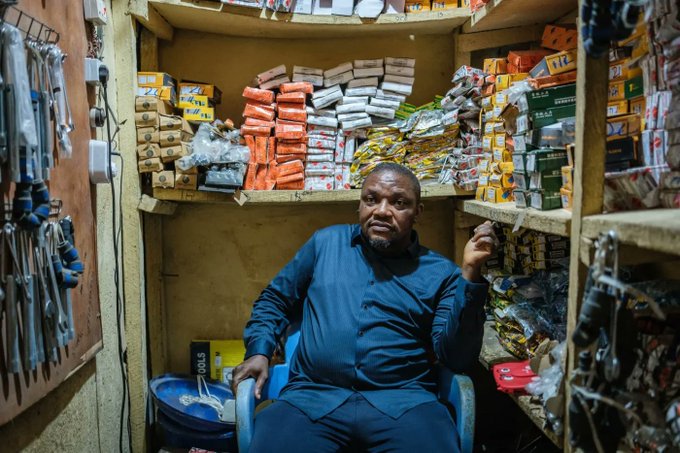
In a crowded market in Onitsha, southeastern Nigeria, Emeka Umeagbalasi makes a modest living selling screwdrivers and wrenches. His small hardware stall blends into a maze of traders hawking farm produce and tools. Yet far from this marketplace, his writings have echoed through the corridors of power in Washington — and, indirectly, over Nigerian airspace.
Umeagbalasi, 56, is the founder of the International Society for Civil Liberties and the Rule of Law (Intersociety), a home-run advocacy group he established in 2008. Through a series of reports, he has advanced the claim that Christians are being systematically targeted for mass قتل in Nigeria. These assertions, despite serious questions about their accuracy, have been cited by prominent U.S. Republican lawmakers, including Senator Ted Cruz and Representatives Riley Moore and Chris Smith.
Armed with this narrative, President Donald Trump authorized U.S. airstrikes in northwestern Nigeria on Christmas Day, framing the action as a response to what the White House described as the “massacre of Christians by radical terrorists.”
To Umeagbalasi, the moment was vindication. “It was miraculous,” he said, warning that “Nigeria will explode” if urgent action is not taken.
Data Built on Assumptions
Umeagbalasi claims that more than 125,000 Christians have been killed in Nigeria since 2009. However, he has acknowledged that much of his data is not independently verified and is largely drawn from secondary sources — including Christian advocacy groups, media reports and online searches.
Nigeria does not publish comprehensive statistics on victims of violence, nor does it record religious affiliation. Many attacks occur in remote areas and go unreported. Independent conflict trackers, such as the Armed Conflict Location and Event Data (ACLED) project, present a far more nuanced picture, showing that violence affects both Christians and Muslims, as well as civilians, insurgents and security forces.
For example, while Umeagbalasi stated that over 7,000 Christians were killed in the first seven months of 2025, ACLED estimates that about 6,700 people in total died during that period — including combatants — with roughly 3,000 confirmed civilian deaths. The data does not break casualties down by religion.
Umeagbalasi admits that he often infers victims’ religious identity based on geography rather than confirmation. Attacks in areas he believes have significant Christian populations are typically counted as Christian casualties, even in regions where Muslims are known to be the majority.
This approach has drawn sharp criticism from analysts and religious leaders alike.
Disputed Narratives, Dangerous Consequences
Security experts warn that framing Nigeria’s complex conflict landscape as a simple religious genocide is misleading and potentially destabilizing. Violence in the country stems from multiple factors: Islamist insurgency, banditry, farmer–herder conflicts, criminal kidnapping networks, weak governance and widespread impunity.
Bishop Matthew Hassan Kukah of Sokoto has cautioned that overemphasis on religious identity obscures the core problem. “The real issue is a weak state that lacks the capacity to protect its citizens — Christians and Muslims alike,” he said.
International Crisis Group analyst Nnamdi Obasi described Intersociety’s methodology as deeply flawed, noting inconsistencies and basic numerical errors in its reports. Nigeria’s Ministry of Foreign Affairs has also rejected claims that the government manipulates religious identities of victims, calling Umeagbalasi’s work biased and performative.
Despite this, his reports continue to circulate among advocacy networks in the United States, often amplified by groups that routinely label attackers as “Fulani militias” — a characterization many researchers say dangerously conflates criminal violence with an entire ethnic group spread across West Africa.
Umeagbalasi himself has used inflammatory language against the Fulani, statements that critics say verge on incitement and ethnic profiling.
Influence Beyond His Reach
From his living room in Onitsha, where shelves of books sit beside plaques praising his “service to humanity,” Umeagbalasi is already drafting his next report, ominously titled “The Situation of Christians in Nigeria Fueled by Jihadist Terrorism Inches a Point of No Return.”
Many Nigerian and international observers fear that when unverified claims are elevated to the level of foreign policy justification, the consequences can be severe — not only risking civilian lives, but also undermining nuanced efforts to address Nigeria’s real security challenges.
As airstrikes and rhetoric intensify, analysts stress the need for evidence-based policy grounded in credible data, not assumptions drawn from Google searches or advocacy echo chambers.
In a nation as complex as Nigeria, they warn, oversimplification can be as dangerous as inaction