

As Africa grapples with a renewed wave of military takeovers from the Sahel to Central Africa, Nigeria—the continent’s largest democracy—has been jolted by revelations surrounding a foiled coup plot allegedly involving senior serving officers of its armed forces.
An exclusive investigation first published by PREMIUM TIMES reveals that 14 of the 16 military officers currently detained over the alleged plot are from the Nigerian Army, with an overwhelming majority drawn from the Infantry Corps, the backbone of Nigeria’s ground combat power.
The disclosures have sent quiet shockwaves through Nigeria’s security establishment and raised urgent questions about command loyalty, force cohesion, and civil–military relations at a time of regional instability.
The Numbers That Alarmed Security Watchers
According to sources familiar with the investigation, the detained officers cut across senior and mid-level command ranks:
-
1 Brigadier General
-
1 Colonel
-
4 Lieutenant Colonels
-
5 Majors
-
2 Captains
-
1 Lieutenant
-
1 Lieutenant Commander (Nigerian Navy)
-
1 Squadron Leader (Nigerian Air Force)
Crucially, 12 of the 14 Army officers belong to the Infantry Corps, the formation that commands the bulk of Nigeria’s fighting troops and operational units nationwide.
Military analysts say this concentration is significant.
“In most African coups, control of infantry formations determines success or failure,” a retired West African defence official told DefenseTimes Africa. “That reality makes this case particularly sensitive.”
Why the Infantry Factor Matters
The Infantry Corps is Nigeria’s frontline force deployed in counter-insurgency operations in the North-East, internal security missions across the federation, and peacekeeping roles abroad.
The alleged involvement of so many infantry officers has fueled concerns within defence circles about:
-
internal command cohesion
-
peer-group influence among officers trained together
-
and the long-term effects of operational fatigue from prolonged internal deployments
Sources cited by PREMIUM TIMES disclosed that many of the officers trained at the Nigerian Defence Academy (NDA) within the same time window, particularly between 2004 and 2008, a factor now under close scrutiny by investigators.
Senior Figures Named in the Probe
Brigadier General Musa Abubakar Sadiq
Born on 3 January 1974, Brigadier General Sadiq (Service No. N/10321) is an Infantry officer and a member of Regular Course 44 of the NDA.
He was commissioned in 1997, promoted to colonel in 2015, and attained the rank of brigadier general in 2019. His past appointments include Commander, 3rd Brigade (Kano) and Garrison Commander, 81 Division (Lagos).
PREMIUM TIMES reported that investigators suspect he may be a central figure in the alleged plot. The officer was also previously detained in October 2024 over unrelated allegations involving diversion of relief materials and disposal of military equipment.
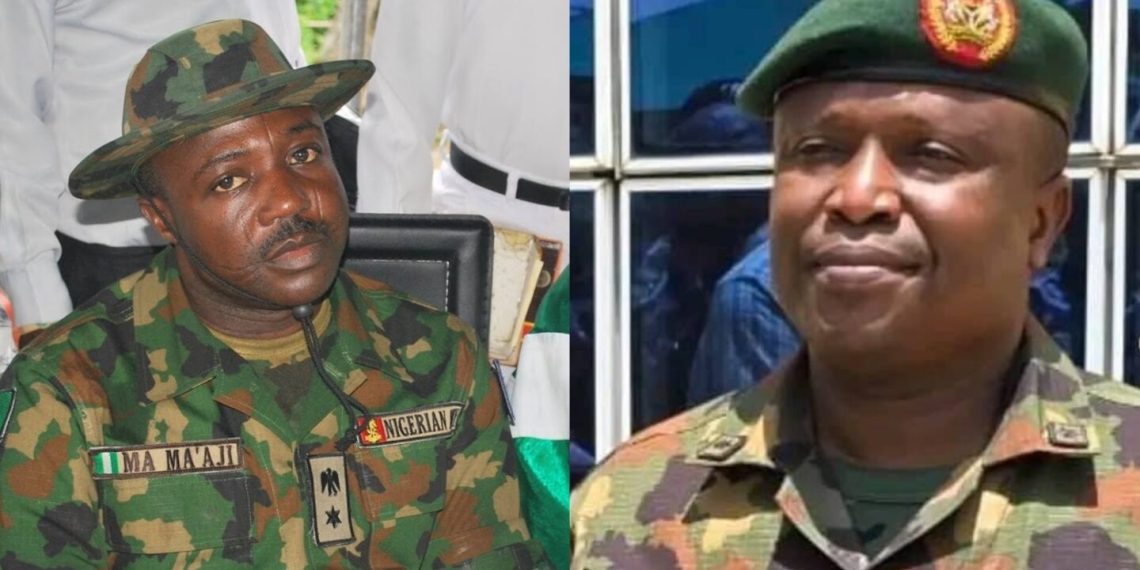
Colonel M.A. Ma’aji
Colonel Ma’aji (Service No. N/10668), an Infantry officer and member of Regular Course 47, was born on 1 March 1976 and hails from Niger State.
He previously commanded the 19 Battalion in Okitipupa, Ondo State, and participated in Operation Crocodile Smile II and Operation Delta Safe. Investigators reportedly view him as a key operational planner, a claim PREMIUM TIMES noted could not be independently verified.
A Cohort Under Scrutiny
Other officers reportedly detained include multiple lieutenant colonels and majors from the Infantry, Signals, and Ordnance Corps—many of whom trained together at the NDA.
Security sources say investigators are examining:
-
shared training history
-
overlapping deployments
-
and informal command networks
Beyond the Army: Navy and Air Force Links
The investigation also reportedly involves:
-
Lieutenant Commander D.B. Abdullahi of the Nigerian Navy
-
Squadron Leader S.B. Adamu of the Nigerian Air Force
While the Army remains the focal point, their inclusion suggests the probe extends beyond a single service branch.
Official Silence, Regional Implications
Nigeria’s Defence Headquarters and the Federal Government have declined to comment publicly on the alleged plot. The military has only stated that the issue was not linked to the subdued Independence Day celebrations on 1 October.
Across Africa, where coups in Mali, Burkina Faso, Guinea, and Niger have reshaped regional security dynamics, analysts warn that how Nigeria manages this case will be closely watched.
“Nigeria has long positioned itself as a stabilising force in West Africa,” a regional security analyst said. “Any perception of internal fracture within its military has continental implications.”
Editor’s Note
This report is a recoin and analytical rewrite based strictly on information originally published by PREMIUM TIMES. All allegations remain under investigation.