


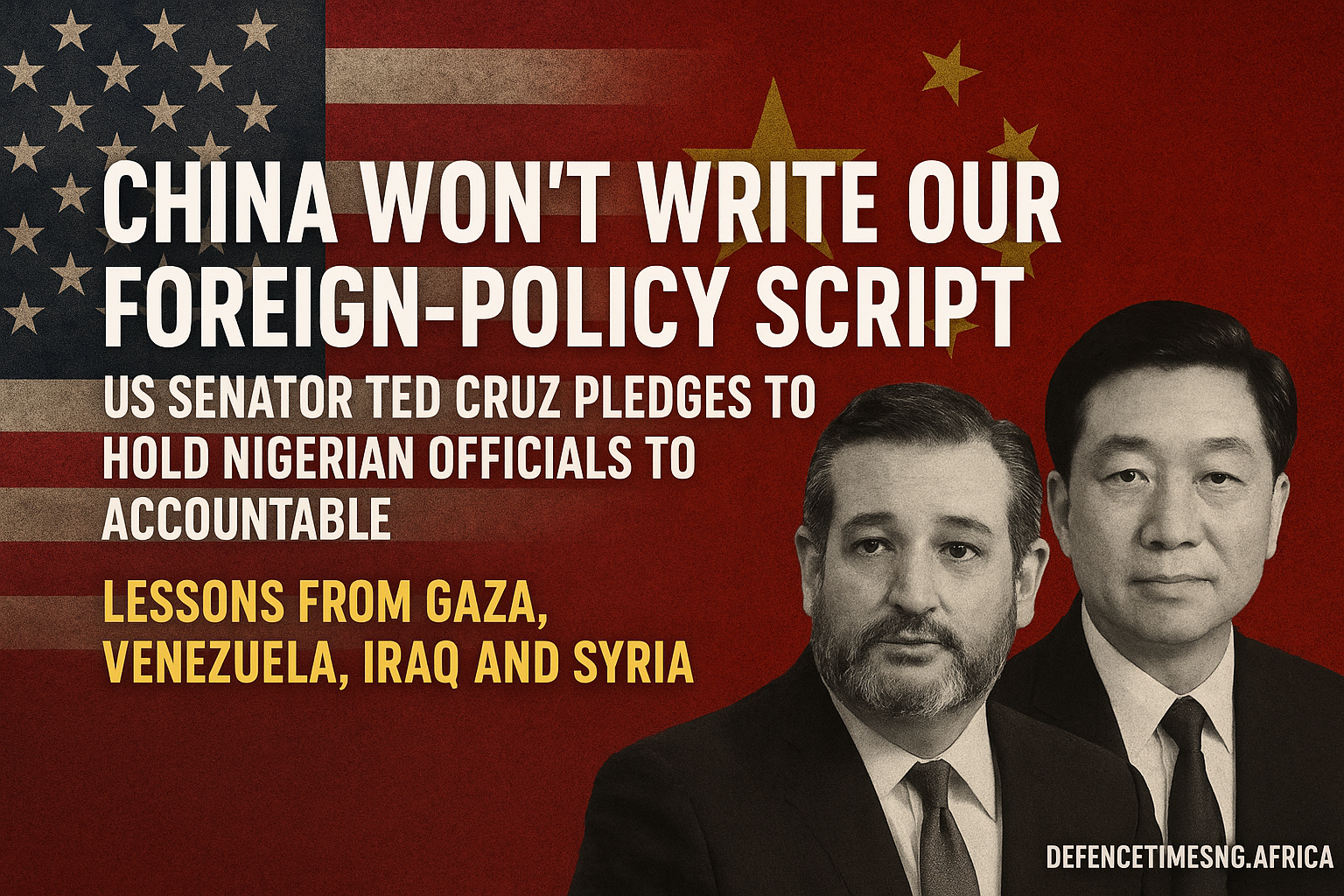
The emerging diplomatic tension between Washington and Beijing over Nigeria’s strategic alignment has entered a sharper phase, as Riley Moore, a member of the US House of Representatives, says China has no right to dictate America’s foreign policy. In support of this view, US Senator Ted Cruz is vowing to hold Nigerian officials accountable amid ongoing commentary on the CPC designation. His statement directly counters China’s recent remarks condemning U.S. pressure on Nigeria, signaling a new theatre in the global great-power contest: Abuja.
This is not merely rhetoric — it is a warning wrapped in strategic memory. From Gaza to Venezuela, Iraq to Syria, global history teaches a clear lesson: nations caught between competing hegemons must act with strategic clarity, not emotional reflex or ideological drift. In each case, where states failed to anchor policy on national interest and disciplined geopolitical intelligence, they became arenas, not actors, in world power struggles.
Nigeria must avoid that fate.
As Africa’s most populous nation and a continental security pivot, Nigeria cannot afford a foreign-policy posture defined by reaction, soft power emotion or misplaced confrontation. The events in Gaza highlight the cost of diplomatic missteps and fragmented alliances; Venezuela demonstrates how international sanction regimes can erode state capacity; Iraq and Syria remain enduring reminders of how global rivalry can fracture sovereign space and destabilize national destiny.
Washington’s message is tactical but clear: Nigeria is expected to align with democratic partners in counter-terrorism, religious freedom and security frameworks — and deviation will attract consequences. Beijing’s counter-narrative — that the U.S. is “bullying” Nigeria speaks to China’s deeper ambition: retaining influence in Nigeria’s economic and security ecosystem without geopolitical contest.
Nigeria must read the room. Neither confrontation with the United States nor blind loyalty to Beijing is a viable path. The modern battlefield is hybrid — information, diplomacy, economic leverage, and security assistance — and the winners are nations that balance power, safeguard sovereignty and negotiate from strength.
Strategic partnership does not mean submission. Sovereignty does not mean isolation. A smart state navigates competition, extracts value, and protects its citizens — not ideological interests of foreign capitals.
Nigeria should therefore pursue a triangular foreign-policy doctrine:
-
Partnership with the U.S. on counter-terrorism, intelligence, democratic norms, and global security frameworks.
-
Constructive economic engagement with China, devoid of strategic capture.
-
Independent African-centred diplomacy, preventing external ideology from shaping internal security posture.
As Senator Cruz signals accountability and Beijing postures against American influence, one truth becomes clear: Nigeria has entered a global strategic spotlight. Our response must reflect maturity, not sentiment; strategy, not reaction; and above all — national interest over foreign affection.
History is speaking — from Gaza’s diplomatic isolation, to Venezuela’s economic siege, to Iraq and Syria’s geopolitical fragmentation. Nigeria must choose the path of sovereign stability, not become the next cautionary tale in the global power contest.
The world is watching. Abuja must move with discipline.